
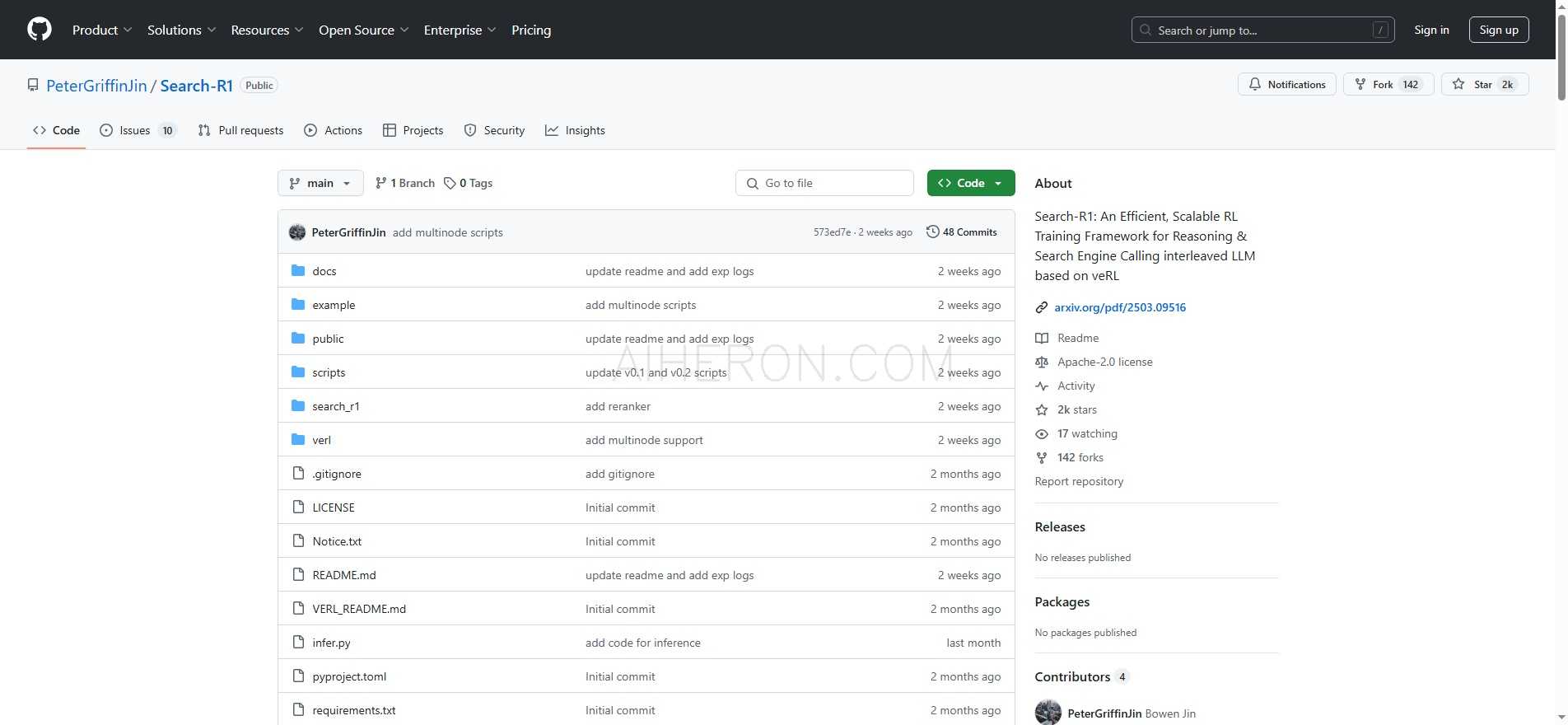
什么是Search-R1: Efficient RL Training Framework for LLMs with Search Engine Integration
Search-R1 is a powerful reinforcement learning framework designed for training language models (LLMs) that can reason and make tool calls—such as to search engines—in a coordinated manner. It builds on the concepts of DeepSeek-R1(-Zero) and incorporates cutting-edge tools like veRL, a reinforcement learning library that facilitates efficient training of models with complex tool interactions. This framework allows LLMs to access external information via search engines, boosting their ability to handle reasoning tasks dynamically and effectively.
Search-R1: Efficient RL Training Framework for LLMs with Search Engine Integration怎么用?
To use Search-R1, follow these steps: 1. Set up the environment using the provided conda commands and install necessary libraries like PyTorch, vLLM, and Flash Attention. 2. Train an LLM (e.g., Llama3 or Qwen2.5) with reinforcement learning methods like PPO. 3. Use your own dataset or pre-built datasets for training. 4. Integrate local or online search engines and make sure the LLM can call these engines during training for information retrieval. 5. Run the model on the inference server and ask the trained model questions to observe its reasoning ability in real-time.
Search-R1: Efficient RL Training Framework for LLMs with Search Engine Integration核心功能
- Search-R1 offers a range of powerful features:
- Support for local sparse and dense retrievers (BM25, ANN, etc.)
- Integration with major search engines like Google and Bing
- Flexible RL methods (PPO, GRPO, reinforce)
- Compatibility with various LLMs (e.g., Llama3, Qwen2.5)
- Open-source RL training pipeline for easy customization and experimentation
Search-R1: Efficient RL Training Framework for LLMs with Search Engine Integration使用案例
- Here are some example use cases for Search-R1:
- Train a reasoning-based LLM using the NQ dataset, integrating the E5 retriever and Wikipedia corpus for real-world information retrieval.
- Conduct multi-turn reasoning tasks where the model interacts with search engines and refines its answers based on subsequent search results.
- Implement a custom search engine setup for specialized domain-specific tasks and incorporate it into the RL training loop.
Search-R1: Efficient RL Training Framework for LLMs with Search Engine Integration价格
Search-R1 is an open-source project, and its codebase can be freely accessed on GitHub. The cost of using it is minimal for small-scale training but may scale with larger datasets and LLMs. For instance, large models like 30B+ parameter LLMs can incur additional computational costs, particularly when running distributed training across multiple nodes.
Search-R1: Efficient RL Training Framework for LLMs with Search Engine Integration公司名称
Search-R1 is developed and maintained by PeterGriffinJin, a contributor to open-source machine learning research.
Search-R1: Efficient RL Training Framework for LLMs with Search Engine Integration联系方式
For inquiries, you can reach the Search-R1 team at the email address: [email protected].
Search-R1: Efficient RL Training Framework for LLMs with Search Engine Integration社交媒体
Stay connected with the Search-R1 team on social media: Twitter: @PeterGriffinJin Instagram: @petergriffinjin
